WAYPOINT
Services

The whole controls spine, or the one piece you need.

Five services, each written from what the practice actually does on real projects. Each says what it covers, what you walk away with, and when to call.

01

Estimating and bid support

Class 5 screening through definitive. Published unit-cost basis, escalation, contingency by class. RFQ packages and bid tabulation.

What it covers

  • Order-of-magnitude and Class 5 estimates for screening and funding decisions, with an explicit basis of estimate
  • Bottoms-up estimates area by area as scope defines — quantities, unit costs, productivity, indirects
  • Escalation and contingency sized to the estimate class, shown below the line where the reader can see them
  • RFQ package preparation, bid solicitation, clarifications, and bid tabulation with a recommendation

What you walk away with

  • Estimate workbook with basis, assumptions and exclusions on the record
  • Escalation model and contingency rationale
  • RFQ package, bid log and tabulation memo

When to call

You need a number you can defend before you commit to it — or someone else’s number checked before you rely on it.

02

Cost engineering

Budget baseline and cost structure, commitment register, forecast at completion, change control that keeps the basis intact.

What it covers

  • Original budget baseline from the approved estimate, with a cost structure the whole team can code to
  • Commitment register — every PO and contract with its value, its nature (firm, budgetary, quoted) and its status
  • Forecast at completion with the method stated, reconciled to what has already been reported
  • Change control: every budget movement as a dated, approved change — never a quiet restatement

What you walk away with

  • Baseline budget and cost breakdown structure
  • Monthly cost report: budget, committed, incurred, forecast, variance — with reasons
  • Change log the auditor can follow

When to call

The project is funded and the numbers now have to hold month over month.

03

Schedule

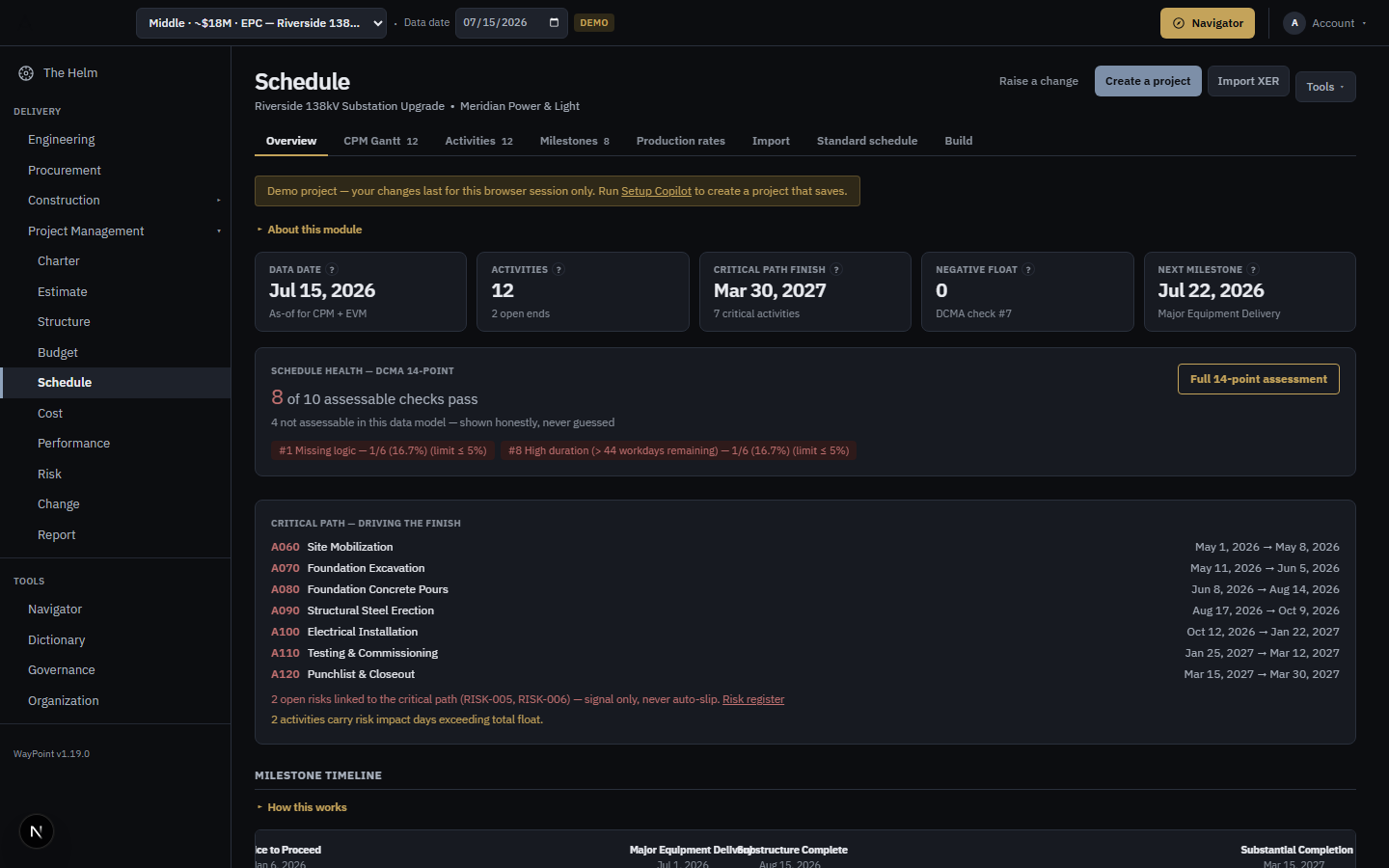
CPM build and review, P6 health checks, data-date discipline, schedule-derived cash flow.

What it covers

  • Baseline schedule development — logic-driven CPM, not a bar chart drawn to a date
  • Independent review of a contractor’s schedule against the DCMA 14-point assessment, with findings explained
  • Progress updates on a fixed data date, float and critical-path reporting the team can act on
  • Time-phased budget and cash flow derived from the schedule, so the S-curve means something

What you walk away with

  • Baseline schedule and basis of schedule
  • Schedule health report with each finding and its consequence
  • Monthly update, look-ahead and cash-flow curve

When to call

You are about to accept a schedule as the baseline, or the one you have has stopped predicting anything.

04

Risk and contingency

Risk register, quantified exposure, contingency sizing and draw-down governance tied to real budget changes.

What it covers

  • Risk identification workshops and a register that carries probability, impact range and an owner
  • Quantified exposure — expected value and range — so contingency is sized from the risks, not from habit
  • Contingency draw-down governance: a risk realizing is a budget change, on the record
  • Quantitative cost-risk analysis when the decision warrants it

What you walk away with

  • Risk register and exposure summary
  • Contingency basis memo
  • Draw-down log reconciled to the budget

When to call

A funding decision, a stage gate, or a contingency balance someone is about to spend.

05

Owner’s representation

Procurement and RFQ management, contractor oversight, monthly reporting the board can read, decisions on the record.

What it covers

  • Running the procurement cycle on the owner’s behalf — scopes, RFQs, evaluations, award recommendations
  • Contractor and engineer oversight against scope, schedule and cost commitments
  • Monthly project report for leadership and the board: where the money is, where the schedule is, what needs a decision
  • A written record of decisions, assumptions and changes as the project moves

What you walk away with

  • Procurement plan, RFQ log and award recommendations
  • Monthly executive report
  • Decision and change record

When to call

You own the project but do not have — or do not want to build — a controls team of your own.

Not sure which one you need?

Bring the problem. Thirty minutes will sort out which of these it is — or whether it is something else.

Or email admin@waypoint-controls.com